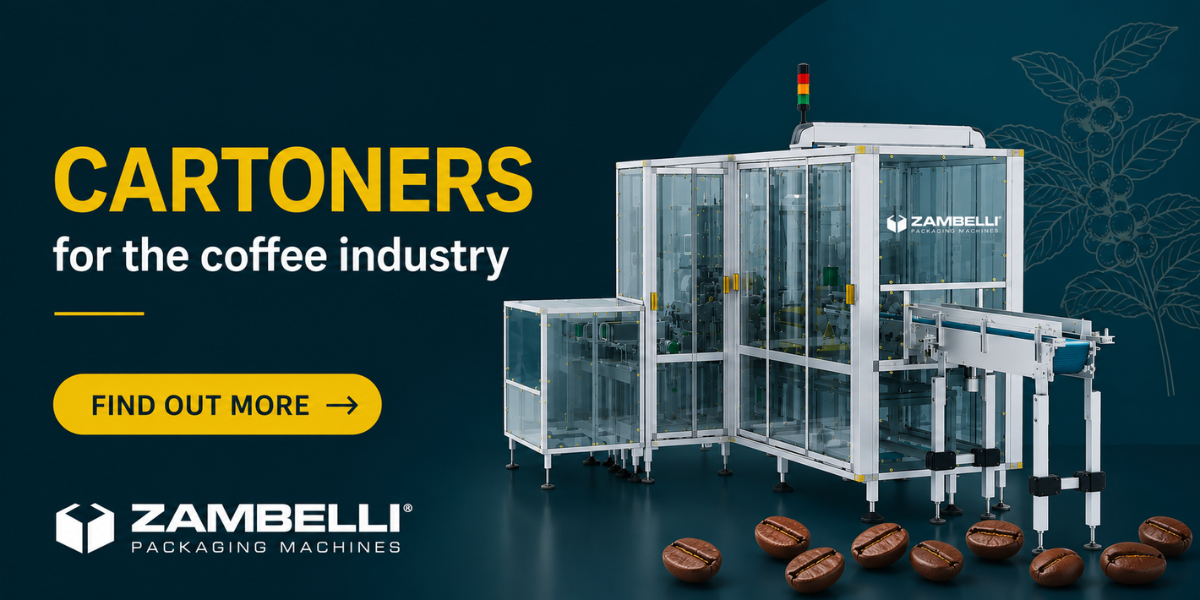
For coffee pod producers, the product range has grown faster than the packaging lines. Different blends, seasonal editions, promotional formats, cartons of 10, 18 or 30 pods, versions for large-scale retail and for the specialty channel: every additional SKU is a different carton to handle. And on the line, every change of SKU means stopping, retooling and starting up again.
Here we're talking about the downstream stage — secondary packaging: the pods are already sealed in their single-dose wrapper, and the job is to collect them and place them into the cardboard carton in the required configuration. It looks like a simple step, but it's also the one that sets the pace of the entire line: a fast, reliable machine that holds its rate and absorbs format changes without long stops makes the difference on cost per pack. In this article we look at why the coffee sector is so demanding on this front, and how Zambelli Packaging cartoners work.
A market squeezing margins
The coffee market is going through unprecedented cost pressure. World production for 2024/25 is estimated at around 174 million 60-kg bags, while global consumption continues to outpace supply, standing above 177 million bags (sources: International Coffee Organization and USDA).
For producers, though, the key figure isn't volume but price: the ICO composite coffee price index has almost tripled in the last two years, driven by low stocks and difficult harvests. When the raw material costs this much, every other cent of cost along the line — energy, waste, downtime — weighs far more heavily on the final margin. Packaging efficiency stops being a technical detail and becomes an economic lever.
At the same time, demand is fragmenting: capsules and single-dose pods, premium products, growing attention to packaging sustainability. On the production side, that means more SKUs, shorter runs and more frequent format changeovers.
Where efficiency is lost on a pod packaging line
When the raw material costs this much, packaging efficiency stops being a technical detail. On a pod line, real efficiency is lost mainly at two points.
The first is the rate. A machine that doesn't hold a steady cadence, or that keeps stopping for micro-stops, drags down the productivity of the entire line, both upstream and downstream. Speed and reliability of the cartoning cycle are therefore the basis of everything.
The second is the format changeover. In coffee pods it's rare to run a single format all day: the same line may switch from a 10-pod carton to a 30-pod one, from one blend to another, from a standard format to a promotional pack.
Every changeover, when handled manually, brings three costs that are often underestimated:
- Machine downtime, during which the line produces nothing.
- The variability of manual adjustment, which depends on the operator and can cause rejects in the first pieces after restart.
- The risk of error when reassembling the parts subject to format change.
A good coffee cartoner therefore has to combine two qualities that are often treated separately: running fast and steadily at full rate, and changing format quickly and without errors.
How Zambelli Packaging cartoners work
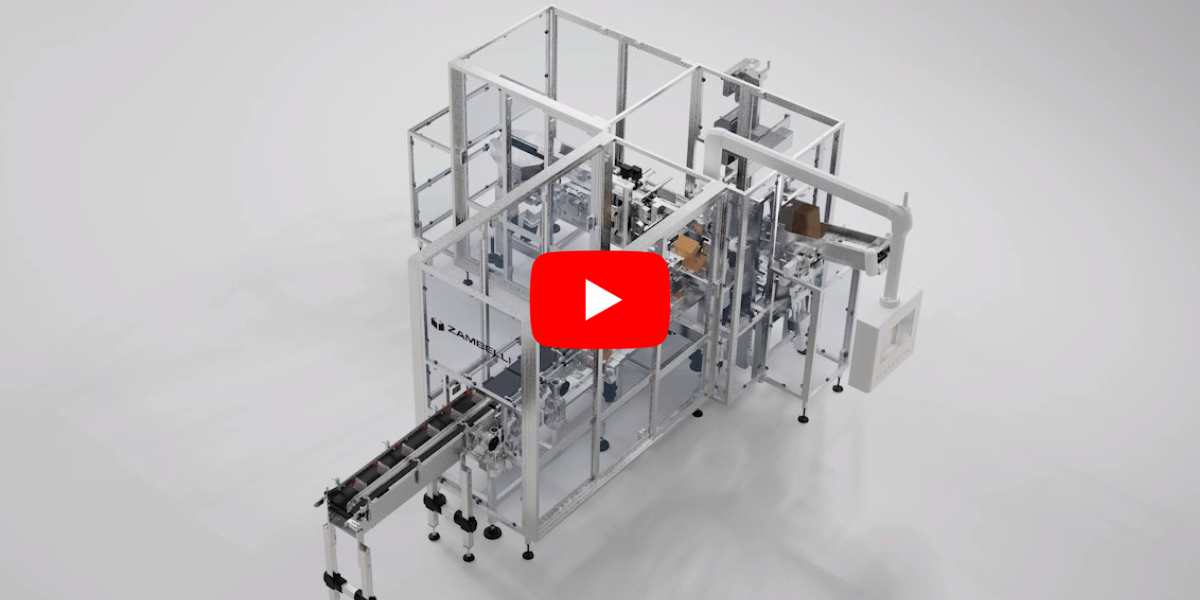
The video above shows where it all starts: a machine running smoothly and fast at full rate. It's this cycle stability — the ability to hold the cadence without micro-stops — that makes the difference to the real productivity of a pod line.
Zambelli Packaging cartoners are designed to pack cartons of different sizes and weights. They are flexible platforms by nature, and it's precisely this flexibility that makes them suited to a multi-format context like coffee pods, where the same machine has to carton single-dose sachets in configurations that change constantly.
Here, the key strength is the automatic format changeover. All the moving parts of the machine subject to format change can be fitted with brushless motors: this means switching from one format to another happens through a motorized, repeatable repositioning rather than manual adjustments. The practical result is a faster and, above all, consistent changeover: the same format recalled two weeks later returns to exactly the same position. The same speed you see in the video, kept even when the range changes.
Maintenance follows the same automation logic: through the PLC, the lubrication pump can be activated automatically for a settable time based on the machine's running hours. A simple function, but one that reduces oversights and keeps operating conditions stable.
An interface that works with the operator
Much of the value of automatic format changeover comes to life on the machine itself, in the day-to-day interaction with the operator. The touch screen PC on Zambelli Packaging cartoners provides, in a single place:
- Alarm notifications, complete with photos and an explanation of how to clear them, so that even a less frequent intervention is guided step by step.
- Video instructions for the format changeover, which standardize the procedure regardless of the individual operator's experience.
- The recommended spare parts list, the wiring diagram and the use-and-maintenance manual, always available directly on the machine.
- Machine performance statistics, to keep the real production trend under control.
These are diagnostic and operational-support functions: they help reduce downtime and make line staff more self-sufficient. They don't replace technical oversight, but they make it more effective.
Why choose Zambelli Packaging for coffee packaging
Zambelli Packaging has been designing and building secondary packaging machines since 1969, with over 2,500 machines installed in more than 60 countries. The approach stays the same whatever the sector: start from the customer's packaging and their real needs, and build the solution around them — with modular, scalable technologies, Industry 4.0 integration and technical support that accompanies the customer from design through to after-sales service.
In the case of coffee pods, this translates into a line able to keep up with the variety of the range without every new format becoming a production problem.
Do you have a growing assortment of pods and are you changing formats more and more frequently?
Do you have a growing pod range and increasingly frequent format changeovers?
Tell us about the formats you handle: together we'll assess how to configure a Zambelli Packaging cartoner for your specific case.